

Dynamic Random Access Memory Market to Grow at 7.6% CAGR, Anticipated to Reach USD 209.4 Billion by 2035
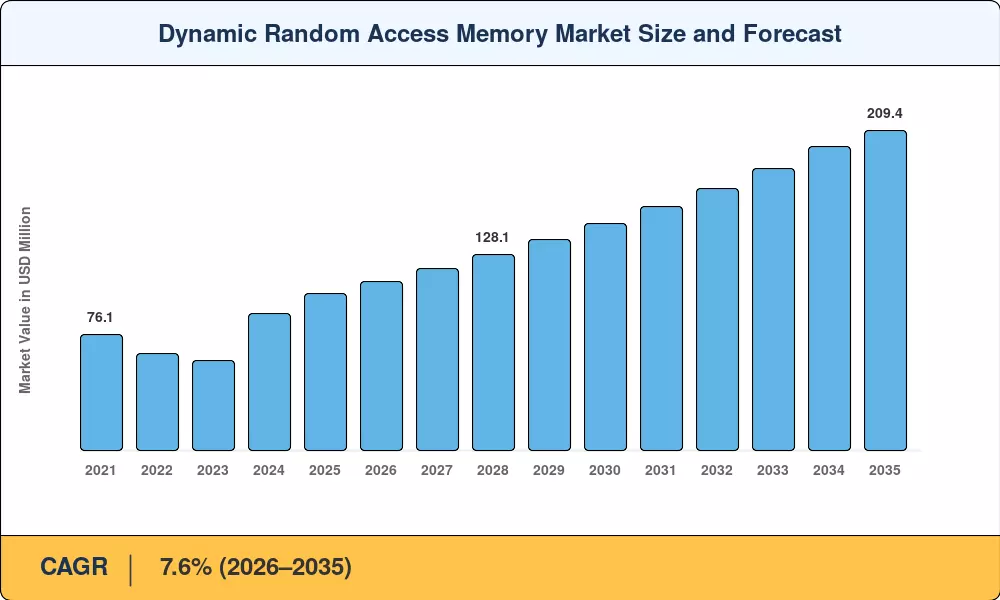
Dynamic Random Access Memory Market
Dynamic Random Access Memory Market grows steadily driven by data centers, AI, and mobile device demand worldwide
Dynamic Random Access Memory Market is witnessing strong expansion driven by AI workloads, cloud computing, and next-generation digital infrastructure demand”
ONTARIO, NEW YORK, CANADA, June 19, 2026 /EINPresswire.com/ -- Dynamic Random Access Memory (DRAM) market represents one of the most critical pillars of the global semiconductor industry, serving as the backbone for computing performance across data centers, consumer electronics, artificial intelligence systems, and advanced industrial applications. As digital transformation accelerates, the demand for high-speed memory solutions has intensified, driven by workloads that require rapid data processing, low latency, and high bandwidth capabilities. DRAM continues to evolve with technological advancements such as DDR5, LPDDR5X, and high-bandwidth memory integrations, enabling superior performance for next-generation devices and cloud infrastructure. — Market Research Future
The expanding ecosystem of connected devices, coupled with exponential data generation, is reinforcing the strategic importance of DRAM manufacturers in global technology supply chains. dynamic random access memory market reached an estimated USD 102.8 billion in 2025, propelled by surging demand from data center operators, AI training clusters, and mobile device manufacturers. Starting from approximately USD 110.6 billion in 2026, the dynamic random access memory market is projected to expand at a CAGR of 7.6% through 2035, reaching USD 209.4 billion by the end of the forecast period.
Leading Industry Participants
The global DRAM market is dominated by a concentrated group of technology giants that command enormous fabrication footprints, advanced process node capabilities, and deep intellectual property portfolios. The key players shaping competition, pricing, and innovation across the DRAM landscape include:
• Samsung Electronics Co., Ltd
• SK Hynix Inc
• Micron Technology, Inc.
• Nanya Technology Corporation
• Winbond Electronics Corporation
• CXMT (ChangXin Memory Technologies)
• Powerchip Semiconductor Manufacturing Corp
• Alliance Memory
• Together
Get a Sample PDF Brochure of the Report - https://www.marketresearchfuture.com/sample_request/38141
Key Growth Factors
The dynamic random access memory market is underpinned by a diverse set of structural growth catalysts that are expected to sustain above-average demand expansion through the forecast period. The proliferation of generative artificial intelligence applications from large language models to image synthesis platforms has dramatically increased per-server DRAM capacity requirements.
AI training servers equipped with high-end accelerators such as NVIDIA H100 and H200 GPUs demand HBM in quantities and at bandwidths that are several orders of magnitude beyond what traditional workloads required. This AI infrastructure buildout is reshaping the mix of DRAM revenues toward higher-value products and is expected to remain a primary demand driver well into the 2030s.
Cloud computing expansion by hyperscalers including Amazon Web Services, Microsoft Azure, Google Cloud, Meta, and Alibaba Cloud continues to stimulate robust server DRAM demand. The global 5G rollout is simultaneously accelerating mobile DRAM content upgrades, as 5G-enabled smartphones consistently require higher LPDDR capacities to handle real-time data streams, AI-on-device inference, and richer media experiences.
Automotive electrification and autonomous driving development are creating new DRAM demand in a sector traditionally dominated by lower-speed memory solutions, as modern ADAS platforms and in-vehicle infotainment systems require automotive-grade LPDDR and DDR memory with stringent reliability requirements.
Emerging Growth Opportunities
Several nascent application areas present significant upside potential for DRAM market participants over the coming decade. Compute Express Link (CXL) memory pooling is emerging as a transformative technology that enables DRAM to be disaggregated from server CPUs, allowing cloud operators to dynamically allocate memory resources across workloads.
This shift to memory-as-a-service architectures could unlock entirely new consumption patterns and revenue streams for DRAM suppliers as CXL 2.0 and 3.0 ecosystems mature through 2027–2030. The technology also opens the door to memory expander modules and CXL-attached DRAM that could dramatically increase total addressable memory capacity within a single server rack.
Processing-In-Memory (PIM) and Near-Memory Computing represent another frontier where DRAM manufacturers are investing heavily to embed computational logic directly within or adjacent to memory arrays, reducing data movement bottlenecks that limit AI workload performance. Edge AI deployments in smart cities, industrial IoT, and healthcare diagnostics are creating distributed DRAM demand nodes that were largely absent from the market five years ago.
Additionally, the expansion of extended reality (XR) headsets, spatial computing platforms, and next-generation gaming consoles is expected to drive incremental demand for high-bandwidth, low-latency DRAM configurations. Defense and aerospace applications, driven by modernization programs, represent a stable high-margin niche where ruggedized and radiation-hardened DRAM variants command significant pricing premiums.
Key Market Barriers & Challenges
Despite its compelling long-term growth profile, the DRAM market faces a constellation of structural and cyclical challenges that can create significant volatility in revenues and profitability. The industry is notorious for its boom-and-bust pricing cycles, where periods of oversupply — triggered by simultaneous capacity expansions among major producers drive prices to below-cost levels, eroding margins across the supply chain.
Managing the timing of capital expenditure and new fab construction against inherently uncertain demand forecasts remains one of the most difficult strategic challenges facing DRAM manufacturers, given that a single cutting-edge fabrication facility can require investment of USD 15–25 billion and a construction-to-production cycle of three or more years.
Geopolitical tensions between the United States and China are creating significant supply chain fragmentation risks. Export controls on advanced semiconductor equipment and chip technologies imposed by the U.S. Department of Commerce, along with retaliatory measures and domestic subsidies in China, are reshaping global production geography and raising uncertainty for multinational supply chains.
The increasing cost and complexity of advancing to sub-1b-nm process nodes poses a fundamental technology challenge, as the laws of physics impose constraints on how aggressively cell dimensions can be scaled while maintaining adequate data retention, refresh characteristics, and signal integrity. Environmental sustainability pressures are also mounting, as DRAM fabs consume vast quantities of ultra-pure water, specialty chemicals, and electrical energy, creating compliance costs and reputational considerations that factor into capital planning decisions.
Segment-wise Market Breakdown
The DRAM market is segmented across multiple dimensions including product type, application, memory interface, and end-use industry. The primary segmentation categories are as follows:
By Product Type:
• DDR4 SDRAM
• DDR5 SDRAM
• LPDDR4/LPDDR4X
• LPDDR5/LPDDR5X
• HBM2/HBM2E
• HBM3/HBM3E
• GDDR6/GDDR6X
• Specialty DRAM.
By Application:
• Servers and Data Centers
• Smartphones and Mobile Devices
• Personal Computers and Laptops
• Graphics Cards and GPUs
• Automotive Electronics
• Networking Equipment
• Consumer Electronics.
By Interface:
• Parallel DRAM Interfaces (DDR standards)
• Serial Interfaces
• Stacked Die Interfaces (HBM, 3D DRAM).
By End-Use Industry:
• IT and Telecommunications
• Automotive
• Industrial Automation
• Healthcare IT
• Aerospace and Defense
• Consumer Electronics.
By Geography:
• North America
• Europe
• Asia-Pacific
• Latin America
• Middle East and Africa.
By Node Technology:
• 1x-nm (Legacy)
• 1y-nm
• 1z-nm
• 1a-nm
• 1b-nm (Advanced)
• Sub-1b-nm (Emerging/Next-Generation).
Among product types, DDR5 and HBM are the fastest-growing segments. DDR5 is being rapidly adopted in server platforms such as Intel Sapphire Rapids and AMD Genoa/Turin, offering nearly double the bandwidth of DDR4. HBM, meanwhile, is experiencing explosive demand from AI chip manufacturers including NVIDIA, AMD, and custom silicon designers at hyperscalers. LPDDR5X continues to lead in premium smartphones, where power efficiency and bandwidth are both paramount. The mobile segment remains the largest single application category by volume, while server and data center applications command the highest average selling prices.
Browse In-depth Market Research Report - https://www.marketresearchfuture.com/reports/dynamic-random-access-memory-market-38141
Geographical Market Insights
Asia-Pacific is by far the dominant region in the global DRAM market, accounting for the majority of both production capacity and consumption. South Korea sits at the epicenter of global DRAM manufacturing, housing the world-class fabrication complexes of Samsung Electronics and SK Hynix in Hwaseong, Icheon, and Cheongju.
Taiwan contributes through Nanya Technology and Winbond, while China's domestic DRAM industry — led by CXMT — is experiencing rapid growth underpinned by government subsidies and national strategic imperatives to reduce semiconductor import dependency. Japan, historically a pioneer in DRAM technology, retains an important role in advanced materials, lithography chemicals, and equipment supply chains, even as its direct chip production footprint has diminished.
North America represents the second-largest regional market by revenue, anchored by Micron Technology's manufacturing presence in Boise, Idaho, and its expanding fabs in Manassas, Virginia, and future greenfield projects supported by the CHIPS and Science Act. The United States is the world's largest consumer of server and data center DRAM, given the concentration of hyperscaler infrastructure in regions like Northern Virginia, Oregon, and Texas.
Europe represents a growing consumption market, particularly in automotive-grade DRAM driven by the continent's strong automotive original equipment manufacturer (OEM) base in Germany, France, and Italy. The Middle East and Africa region, while currently a modest contributor to global DRAM revenues, is attracting growing data center investment in the UAE and Saudi Arabia, which is expected to incrementally expand regional demand through the forecast period.
Frequently Asked Questions (FAQs)
Q1. What is the Dynamic Random Access Memory market?
The DRAM market refers to the global industry involved in manufacturing and supplying high-speed volatile memory used in computers, smartphones, servers, and electronic devices.
Q2. What is driving the growth of the DRAM market?
The market is driven by rising demand for data centers, AI computing, smartphones, cloud infrastructure, and advanced automotive systems.
Q3. Which companies dominate the DRAM industry?
Key players include Samsung Electronics, SK hynix, and Micron Technology, along with several other regional manufacturers.
Q4. What are the main applications of DRAM?
DRAM is widely used in servers, PCs, mobile devices, gaming consoles, automotive electronics, and industrial systems.
Q5. Which region leads the DRAM market?
Asia-Pacific leads the global DRAM market due to strong manufacturing capabilities and semiconductor supply chain concentration.
➤➤ Discover More Insights with Market Research Future:
Webtoons Market-
https://www.marketresearchfuture.com/reports/webtoons-market-12024
Video Conferencing Market-
https://www.marketresearchfuture.com/reports/video-conferencing-market-12044
Immersive Technology Market-
https://www.marketresearchfuture.com/reports/immersive-technology-market-12127
Immersive Technology In Education Market-
https://www.marketresearchfuture.com/reports/immersive-technology-in-education-sector-market-12134
Digital Identity In Healthcare Market-
https://www.marketresearchfuture.com/reports/digital-identity-in-healthcare-market-12145
Applied Ai In Retail & E-Commerce Market-
https://www.marketresearchfuture.com/reports/applied-ai-in-retail-e-commerce-market-12181
Generative Ai In Energy Market-
https://www.marketresearchfuture.com/reports/generative-ai-in-energy-market-12185
Palm Recognition Market-
https://www.marketresearchfuture.com/reports/palm-recognition-market-12195
Wholesale Telecom Market-
https://www.marketresearchfuture.com/reports/wholesale-telecom-market-12196
Digital Railway Market-
https://www.marketresearchfuture.com/reports/digital-railway-market-12220
Sagar Kadam
Market Research Future
+ +1 628-258-0071
email us here
Visit us on social media:
LinkedIn
Facebook
X
Legal Disclaimer:
EIN Presswire provides this news content "as is" without warranty of any kind. We do not accept any responsibility or liability for the accuracy, content, images, videos, licenses, completeness, legality, or reliability of the information contained in this article. If you have any complaints or copyright issues related to this article, kindly contact the author above.
